Understanding What You Are Looking At
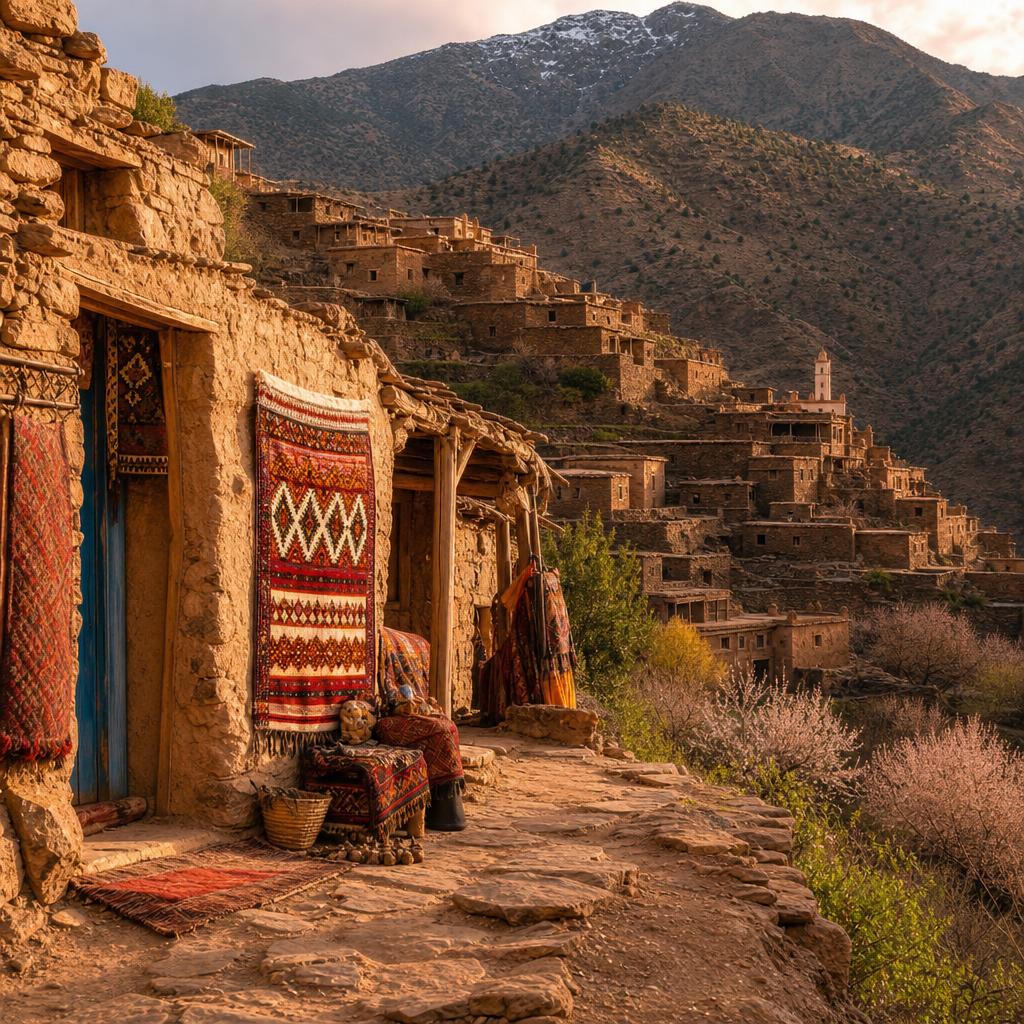
The Middle Atlas has a living tradition of Amazigh textile production — woven carpets, blankets and flat-weave kilims made on vertical looms using wool that has often been hand-spun and dyed with natural or synthetic colour. Each producing community has its own geometric vocabulary, colour palette and structural technique that reflects its specific cultural heritage. A carpet from a village near Azrou is genuinely different from one made in Fes or Marrakech — it carries a distinct regional identity.
Pottery, carved cedar wood, embroidery and silverwork are also produced in the Middle Atlas region, though the concentration and availability varies. When shopping in Azrou or nearby villages, the first useful question is whether the item in front of you was made locally or sourced from a larger craft centre for resale. Most sellers will answer honestly if asked directly. Your guide can help you identify what is produced locally and what is not.
Asking About Authorship and Provenance
The most important question when buying a craft is: 'Did you make this?' or 'Who made this?' A vendor who can answer specifically — naming the artisan, the village or the cooperative — is selling you something with a story. A vendor who deflects or generalises is likely selling a mass-produced or regionally-sourced item, which is not inherently wrong but deserves a different price expectation.
Cooperatives that work directly with Amazigh weavers are found in and around Azrou. These structures — when they genuinely pass revenue back to producers — represent a more reliable way to buy with confidence about provenance. Your guide may be able to introduce you to a weaver directly, which makes the exchange more personal and removes any intermediary markup. Verify anything your guide recommends independently if you want to be thorough — their knowledge is valuable, but a direct conversation with a producer is always best.
- Ask who made the item and where
- Ask whether the dyes are natural or synthetic — both are valid, but the answer tells you something about the process
- For carpets and textiles, ask how long the piece took to make
- Look for asymmetry and slight irregularity as signs of genuine handcraft rather than machine production
- If buying through a cooperative, ask what percentage reaches the maker
Thinking About Price and Value
A handwoven Amazigh carpet that took several weeks to make is worth a different price than a machine-loomed equivalent that resembles it superficially. When considering value, think about the labour rather than comparing to a price you might pay at home. A piece that is genuinely handmade, using traditional technique, by an artisan who will see the money is worth more than its square-metre equivalent from a tourist shop on a main road.
Negotiating in good faith — starting from a position of respect for the work rather than a desire to minimise cost — usually produces a better transaction for everyone. If the price feels honestly high for your budget, say so respectfully and ask whether a smaller piece is available. If the price is comfortably within your budget, there is no social obligation to negotiate down simply because the culture permits it. Paying a fair price for excellent work is the most straightforward way to support an artisan economy.
Caring for What You Buy
A hand-spun, natural-dye wool textile requires different care from a synthetic equivalent. Asking the seller for care instructions before you leave is practical and also signals that you regard the piece as something worth maintaining. Most Amazigh weavers are happy to explain how to clean and store their work — it is a reasonable and appreciated question.
When you return home, the story you attach to a craft matters as much as the object. A carpet bought after a conversation with the weaver — understanding the geometric patterns, the village it came from, the name of the person who made it — carries cultural meaning that a souvenir cannot. This is what responsible craft buying achieves: it connects two people through an object and leaves something meaningful on both sides.