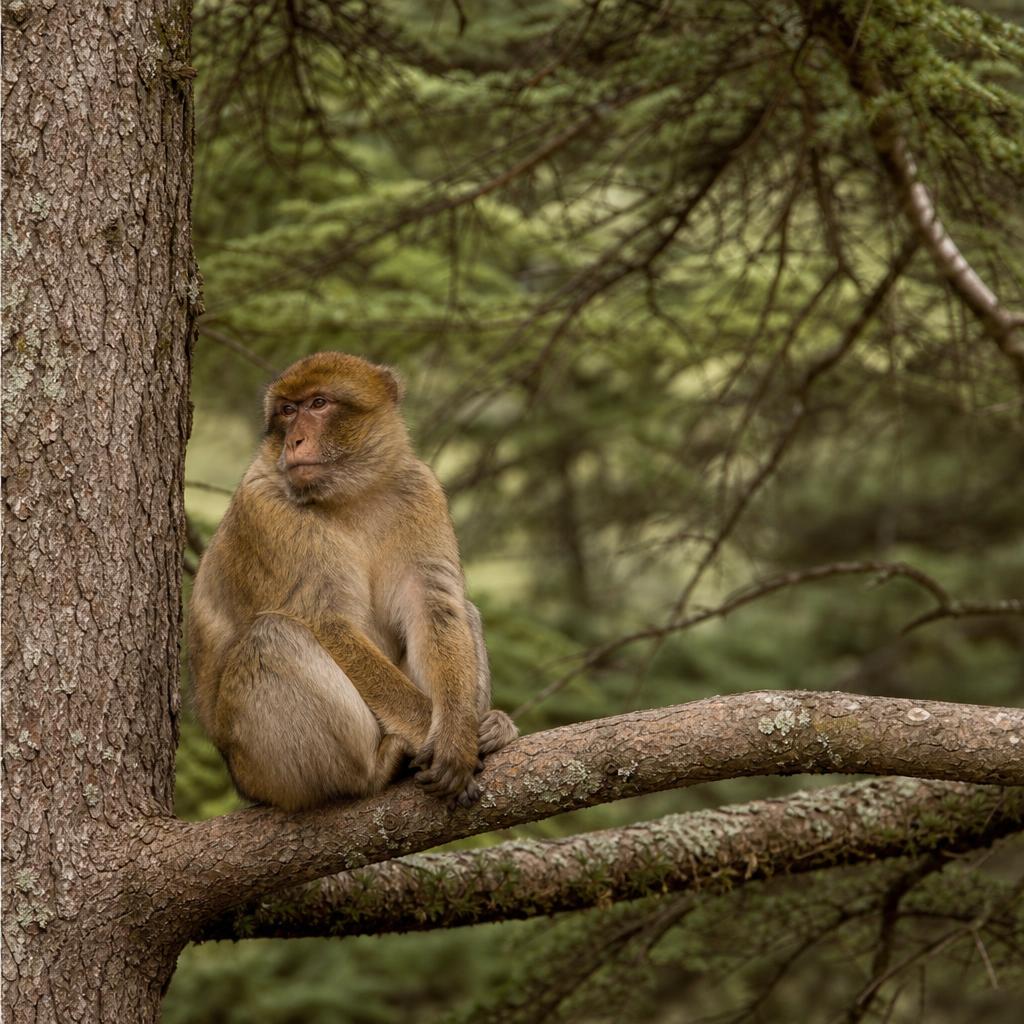
What Roadside Macaque Photo Stops Actually Are
Along the main roads passing through or near the cedar forest between Azrou and Ifrane, it is common to see men or boys standing roadside with macaques on their arms or shoulders, inviting drivers and tourists to stop, photograph the animals, and pay for the interaction. These are not wildlife encounters: the macaques have been removed from their troops, conditioned with food to tolerate close human handling, and are used daily in situations that are stressful, isolating, and physically damaging to the animals.
The practice is well documented by wildlife welfare organizations, and conservation groups working in Morocco have noted its negative effects on macaque populations and behavior. Animals kept for roadside photo work show signs of stress, nutritional deficiency from an unnatural diet, and behavioral abnormalities that make reintegration into wild troops extremely difficult. The money paid for these interactions does not benefit conservation in any way and directly funds continued exploitation.
How Baiting Harms Wild Troops in the Forest
The effects of animal baiting extend beyond individual exploited animals into the broader wild population inside the forest. When tour operators or individual guides bring food into the forest to attract macaques for photographs — nuts, fruit, seeds — they create dependency on human food sources, increase aggression between individuals competing for the handout, and concentrate troops around human access routes rather than their natural foraging territories. Over repeated baiting sessions, this changes troop behavior in ways that take years to reverse even after the practice stops.
Macaques that are regularly baited become habituated to human presence in ways that remove the natural caution that protects them from harm. They approach roads more frequently, come into conflict with vehicles, and may be perceived as threatening by visitors unfamiliar with their size and strength, leading to further negative interactions. Baiting is not a harmless shortcut to a better photograph — it is a sustained form of habitat disruption with long-term population-level consequences.
Recognizing Ethical Wildlife Encounters
An ethical macaque encounter in the Azrou cedar forest is recognizable by a few clear markers. It begins with a briefing that explicitly states no feeding and establishes a respectful observation distance. The guide moves slowly and quietly, and the group stays together in a compact unit that does not surround or corner the animals. The encounter ends when the troop shows signs of stress or moves away — not when the guide decides the group has enough photographs. No food is visible, offered, or used to attract attention.
Ethical tour operators are also transparent about uncertainty: they cannot guarantee macaque sightings on any specific day, and they will not reroute or push into a sensitive forest area to fulfill that expectation. A guide who says 'we may see macaques if conditions are right' is being honest. A guide who promises close encounters and then produces them through baiting is delivering an experience that harms the animals whose wellbeing both of you should care about.
What to Do Instead — and How to Report Concerns
Booking a wildlife tour with a guide who has made an explicit commitment to no-feeding, no-baiting, observation-only encounters is the most direct alternative to roadside photo stops. These tours may result in shorter or more distant encounters — you might watch a troop from 20 meters rather than touching an animal on your arm — but they produce authentic wildlife experiences and contribute to the long-term survival of the population you came to see.
If you observe roadside baiting or feeding within the forest, you can report it to your guide, to local forestry authorities, or to wildlife welfare organizations operating in Morocco. Your guide can advise on the most appropriate local contact. Social media visibility of these practices — shared factually and without sensationalizing — also contributes to the public awareness that drives regulatory change. Responsible travelers are not passive observers; your choices and your voice matter.
- Do not stop at roadside macaque photo opportunities — drive or walk past without engagement
- Do not pay for any photograph involving an animal on a human's arm or shoulder
- Book wildlife tours only with guides who explicitly commit to no-feeding policies
- Report observed baiting to your guide or local forestry authorities
- Share factual information about this practice when you recommend Azrou to other travelers