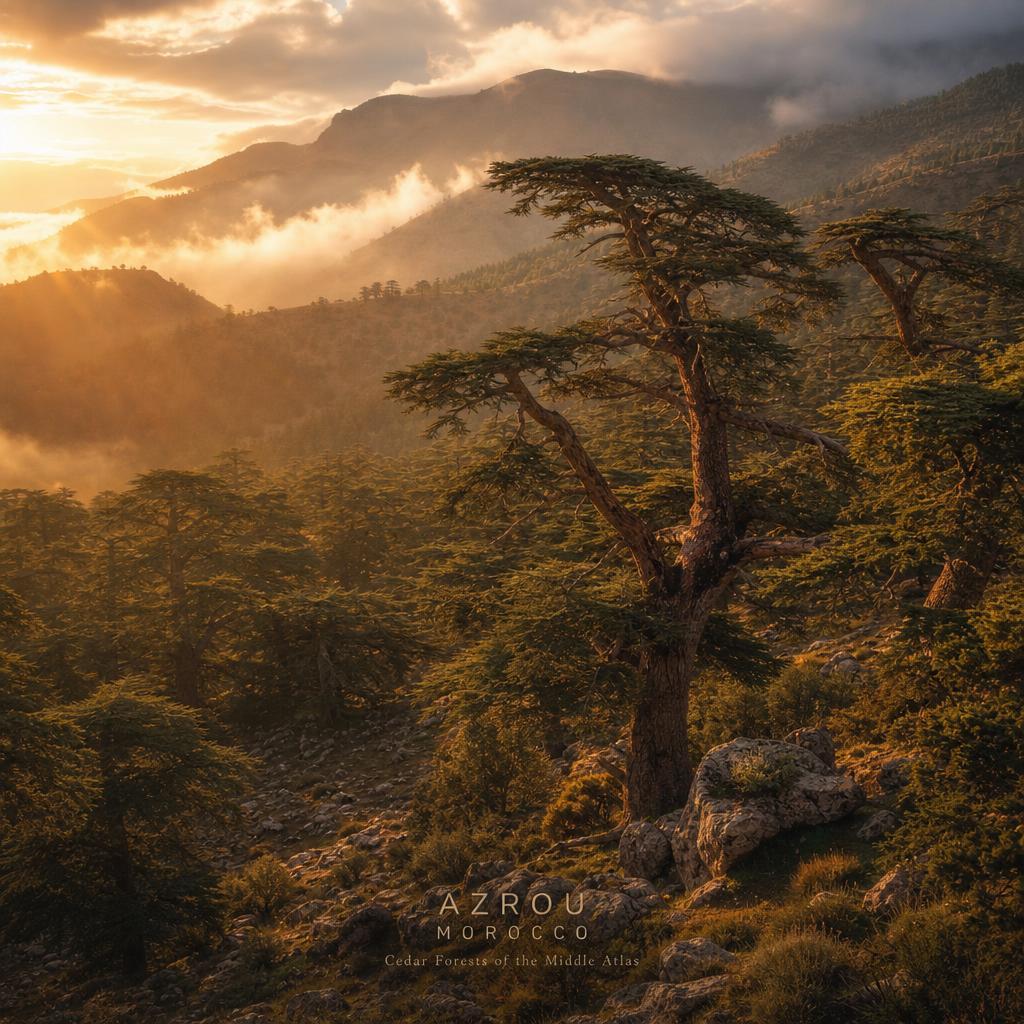
Where the Forest Begins
The cedar forest near Azrou forms part of a much larger Middle Atlas forest belt that stretches across several hundred kilometres of mountain terrain. The section most accessible from Azrou town lies to the north along the road toward Ifrane, and you will notice the tree line shifting from scrubland to genuine high-canopy forest within a short drive or a twenty-to-thirty-minute walk from the centre. The trees here are Atlas cedars — a species native to North Africa — and the oldest individuals are genuinely ancient, their trunks thick enough that two adults cannot join hands around them.
Arrival feels different depending on how you approach. Arriving by car means you can park near one of the informal clearings and step directly beneath the canopy. Arriving on foot from the town gives you a gradual transition: roadside oaks give way to the first scattered cedars, and then the forest closes in properly. Neither route is wrong, but walking in lets your eyes and ears adjust before the full forest wraps around you. Ask locally or confirm with your guide whether the track you plan to use is currently accessible, as conditions can shift with seasonal rainfall.
What You Will Actually See and Hear
On a first walk you are likely to notice the scale before anything else. Atlas cedars can reach thirty metres in height, and beneath a mature grove the light becomes filtered and green-tinted, the temperature drops a few degrees, and the ground cover changes from exposed rock to needle duff and low shrubs. Bird calls carry further than in open countryside: look up toward the canopy and you may spot a Levaillant's woodpecker working the bark, or hear the liquid notes of a blackbird drifting between trunks. If conditions are right you may also encounter Barbary macaques, though sightings are never guaranteed and their location changes daily.
The sound of the forest is one of its least-described qualities. On calm days the canopy creates a partial wind-buffer, and the resulting quiet feels distinct from ordinary countryside silence — closer to a building's interior hush than an open-sky stillness. Early mornings amplify this. Weekdays are generally quieter than weekends, and the central areas near the road see more foot traffic than the paths that branch inward. Plan for at least ninety minutes on your first visit so you have time to stop, look around and take the place in rather than treating it as a box to tick.
- Dress in layers: forest shade can be noticeably cooler than the open road
- Closed shoes or hiking footwear handles the uneven needle-covered ground better than sandals
- Bring water — there are no refreshment stalls inside the forest paths
- A small daypack keeps your hands free for photographs or balance on rooted trails
Reading the Landscape as You Walk
The topography of the Azrou cedar forest is not flat. The terrain rises and falls with the contours of the Middle Atlas, and even a short walk will take you over ridges, into shallow gullies and across clearings where the full sky opens up suddenly between the trees. These clearings are worth pausing in: the contrast between the enclosed forest interior and an open meadow with Atlas ridgelines visible in the distance is one of the landscape's signature moments. Carry a sense of direction — the sun, the sound of the road or a mobile signal on a map application — so you feel oriented rather than adrift.
The forest is not a single uniform block. Cedar dominates the higher, wetter sections, while holm oak appears on drier slopes and transitions mark themselves with mixed understorey and different bird communities. A guide who knows these transitions can help you read what you are walking through rather than experiencing it as an undifferentiated green mass. If you are visiting alone, keep to paths you can backtrack clearly: the terrain can disorient quickly once the road is out of sight.
Making the Most of Your First Hour
Resist the impulse to walk as far as possible in the first session. The cedar forest rewards attention to detail: the grain of bark, the way a cedar bough angles away from the trunk, the lichen patterns at your feet, the sudden depth of a forest gully. Slow down earlier than feels natural and you will notice far more than if you tick off distance. This is especially true if you have children or anyone in the group who benefits from a gentler pace — the forest's magic is cumulative and unhurried.
Before you leave the forest, take a moment to note what surprised you. Was it the size of the trees? The bird calls you could not identify? The way the light moved? Those observations are the starting point for a second, deeper visit. Many travellers who spend only an hour on their first pass return the following morning for a longer walk — often the best indicator that a first orientation worked exactly as it should.