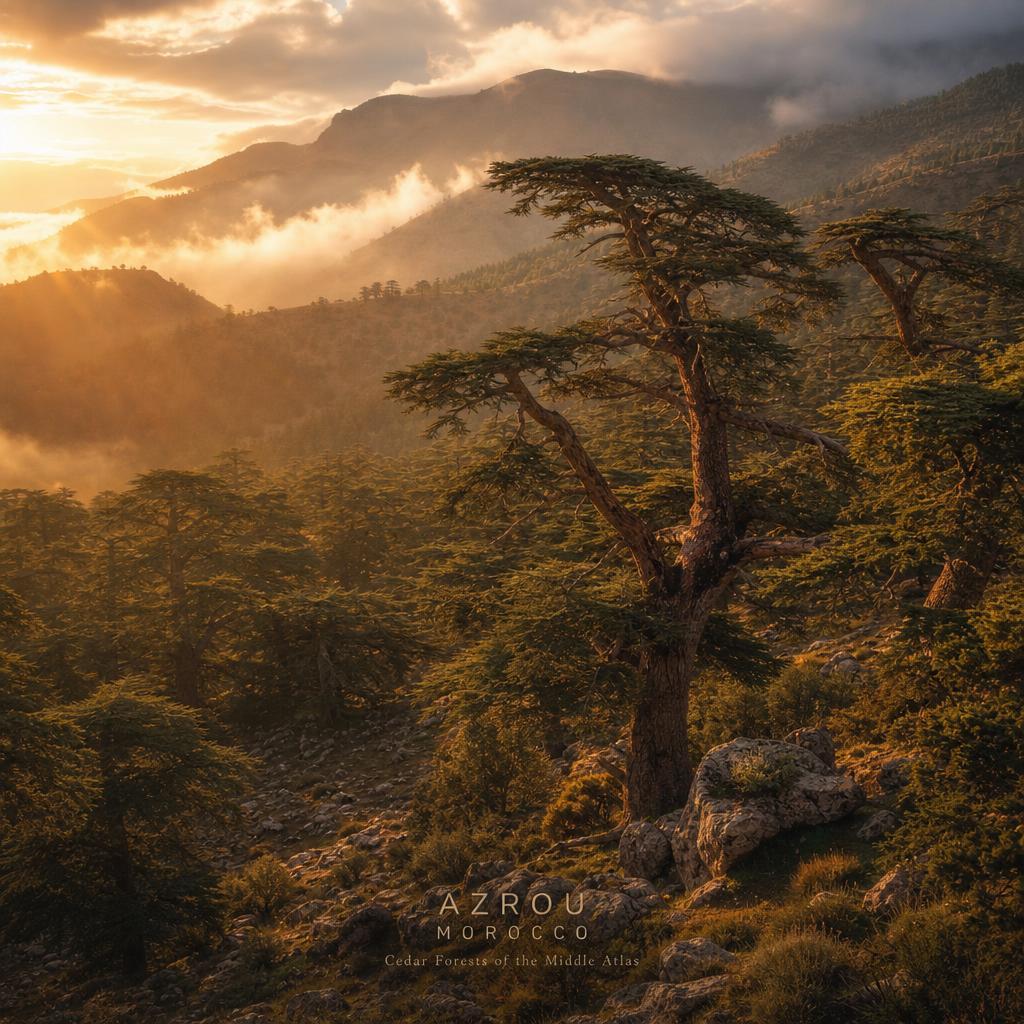
Wide Angle: Forest Interiors and Dramatic Sky
In the enclosed cedar forest, a wide or ultra-wide lens (14 mm to 24 mm full-frame equivalent) allows you to include large trunks in the foreground while showing the canopy overhead and the path receding into the distance. This captures scale in a way that longer focal lengths cannot — the exaggerated perspective of a wide lens emphasises the enormous size of the oldest cedars. The main discipline required is ensuring the foreground element (usually a trunk base, roots or a mossy log) is genuinely interesting, as a wide lens with a weak foreground produces an empty lower frame.
For open plateau and ridge panoramas above the forest, a wide angle is equally effective. The Middle Atlas sky is often dramatic — big cumulus clouds over flat plateau, or low cloud sitting on the cedar ridges — and a 17 mm to 24 mm lens includes enough sky to make atmospheric conditions a compositional asset rather than an afterthought. Lens distortion at ultra-wide settings can make horizons appear curved; check your camera's lens correction profile is applied in post-processing if this bothers you.
- Wide (14–24 mm): enclosed forest interiors, dramatic sky, emphasising scale
- Standard (35–50 mm): village streets, tea scenes, documentary-style forest portraits
- Short telephoto (85–135 mm): isolating individual trees, compressing mountain layers
- Long telephoto (200–400 mm): wildlife at ethical distance, distant ridge details
Standard and Short Telephoto: Village Scenes and Forest Textures
A 35 mm to 50 mm lens on a full-frame camera (or its equivalent on a cropped sensor) renders scenes close to how we perceive them naturally, which makes it effective for village streets, courtyard scenes and the inside of a traditional tea setting. It does not distort faces or architectural proportions, which matters for respectful photography of people and places. If you carry only one lens for a cultural day, a 35 mm or 50 mm prime is a sensible choice for its combination of optical quality, low weight and low visual intrusiveness.
For forest textures — bark patterns, lichen, moss, the layered structure of old cedar roots — a short telephoto macro or close-focus lens (90 mm to 105 mm macro, or a dedicated close-focus prime) rewards slow walkers who stop to examine what is directly in front of them rather than scanning the distant horizon. These close-up images often add strong variety to a landscape set; the contrast between a wide forest overview and an extreme bark detail tells a more complete story about the ecosystem.
Long Telephoto: Wildlife and Compressing Mountain Distance
A 200 mm to 400 mm zoom is the responsible choice for macaque photography (maintaining ethical distance while still obtaining frame-filling shots) but it also has a second use in the Middle Atlas landscape: compressing layers of ridges. The Atlas mountains stack row upon row when viewed from certain plateau viewpoints, and a long telephoto collapses this into a single dense image of overlapping ridges and forest that wide lenses spread apart and flatten. Golden hour light at 300 mm or 400 mm on a distant cedar-covered ridge can produce genuinely striking results.
Weight is the main constraint for travelling photographers considering a long telephoto. A 100–400 mm zoom or a 150–600 mm zoom handles both wildlife and landscape compression from one lens but adds meaningful pack weight. If you prefer to travel light, a 70–300 mm zoom or even a 70–200 mm f/4 covers most Middle Atlas needs at manageable weight and offers significant telephoto reach for a day's walk in the forest and on the plateau.
Practical Lens Kit for a Middle Atlas Photography Day
For a one-bag Middle Atlas photography day, a practical kit depends on your priorities. If wildlife is the focus, prioritise the telephoto and bring a wide prime for forest landscapes as a second lens. If cultural scenes and forest textures are the goal, a 24–70 mm f/2.8 or the equivalent zoom handles the full range without a lens change. For dedicated sunrise forest work, a wide prime and a short telephoto are a complementary pairing that adds very little weight.
Protect your gear from the Middle Atlas combination of morning mist, afternoon dust and the occasional summer thunderstorm. A rain cover for your camera bag and a UV or protective filter on each lens costs little and prevents damage that would end a photography trip early. Clean and dry your gear thoroughly at the end of each day, as cedar forest humidity — particularly in spring and autumn — encourages mould growth on unprotected glass over time.