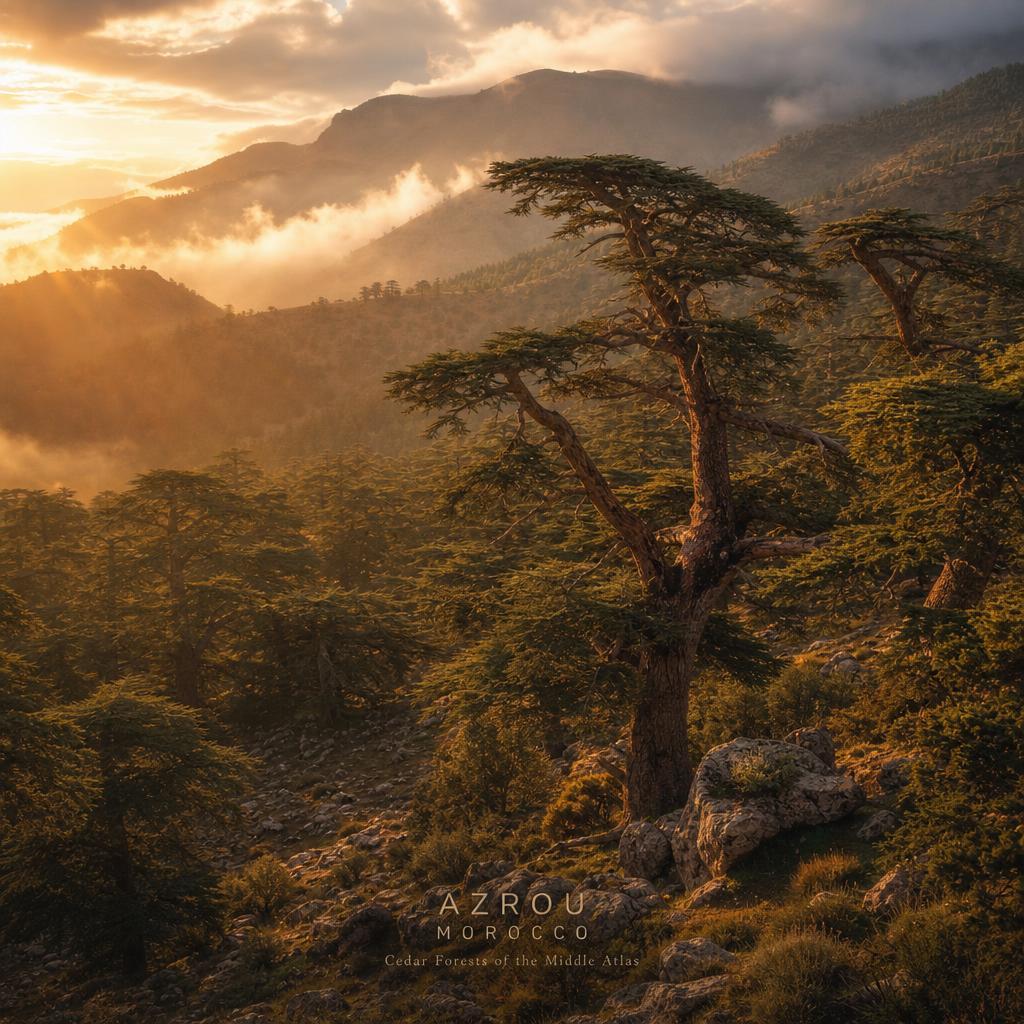
Why Sunrise Changes the Forest
The quality of light in the first hour after dawn is fundamentally different from midday forest light. The sun rises at a shallow angle, sending long horizontal shafts of illumination between the cedar trunks rather than diffused vertical light from above. These shafts travel fifty metres or more through the forest interior, lighting up columns of morning mist or pollen that are invisible by nine o'clock. The visual effect is described by almost everyone who sees it the same way: like a cathedral lit by candles placed along the floor rather than the ceiling. No filter or post-processing creates this quality in a photograph; it exists only in the conditions.
Beyond light, the pre-dawn and dawn forest operates in a different acoustic register. The bird chorus in the Azrou cedar forest begins before it is fully light — robins first, then blackbirds, then the woodpeckers and the mixed tit flocks moving through the canopy. By the time sunrise actually arrives, the forest is already fully alive with sound, but the sound is only birds and wind; there are no vehicles, no voices, no distant engines. For most visitors this is the rarest quality of the early forest walk: genuine natural sound as the dominant experience.
Preparing for an Early Forest Walk
A sunrise forest walk requires more preparation than a midday outing. The pre-dawn period in the Middle Atlas can be significantly cold — even in summer, temperatures inside the cedar forest in the hour before sunrise may be ten to fifteen degrees below afternoon levels. A warm mid-layer and a windproof outer shell are not optional; they are the difference between an uncomfortable trudge and an enjoyable hour. Lightweight gloves are useful in spring and autumn, and from late October through March a hat is genuinely required.
Navigating to the forest entry point before full daylight requires a simple handheld torch or a reliable headtorch; phone torch functions are adequate but leave your hands occupied. If you are walking with a guide, they will manage the navigation, but personal lighting remains useful on uneven early paths. Closed, grippy footwear handles the dew-wet needle carpet better than any other option. Tell your accommodation that you have an early departure and ask them to confirm that the entrance will be available — some guesthouses lock street-facing doors and gates overnight.
- Warm base layer, mid-layer and windproof shell — temperature is significantly colder than expected
- Headtorch or small torch for the approach before dawn light
- Closed shoes with grip — the forest floor is dew-wet until mid-morning in summer
- Flask of hot drink — a pre-poured thermos is more practical than trying to buy anything at that hour
- Camera batteries last shorter in cold — carry a spare in an inside pocket
What Actually Happens During the Walk
A well-planned sunrise forest walk starts with arrival at the forest edge while it is still dark — roughly thirty to forty-five minutes before sunrise. This gives your eyes time to adjust, allows you to settle in a good position and lets the forest's undisturbed patterns re-establish after your arrival. You will hear the bird chorus build before you can fully see the canopy it is coming from. The light comes gradually: first a pale brightening of the sky above the eastern ridgeline, then a shift in the forest from grey to green-grey, then the first amber light touching the highest cedar crowns.
The full golden period — when horizontal shafts of sunrise light penetrate the forest interior — typically lasts between twenty and forty minutes before the sun climbs high enough to change the angle. Experienced forest photographers know this window exactly; first-time visitors are usually surprised by how quickly it passes. Planning a route that positions you inside the mature grove during this window, rather than on the forest edge, requires knowledge of where the light enters from the east — another practical advantage of walking with a local guide who has observed the sunrise there repeatedly.
After Sunrise: The Forest in the Morning
The hour after full sunrise retains some of the early magic while adding warmth and visibility. This is a useful window for photography that needs definition rather than atmosphere, for bird identification, and for observing macaque activity, which often peaks in the first two hours of the morning when the troop is freshly mobile and feeding. Morning dew on the lower vegetation and cedar bark creates surface texture that catches light particularly well in this period.
Most sunrise walkers plan to return to Azrou by mid-morning, arriving back with a productive day already complete and the rest of the day available for other activities. This is one of the practical attractions of the sunrise walk beyond its aesthetic rewards: done well, it uses hours that are otherwise empty (the early morning in a small town before cafes open) to produce an experience that the rest of the day cannot replicate. It is also one of the most consistently mentioned highlights by visitors who have tried it, which is the simplest possible endorsement.