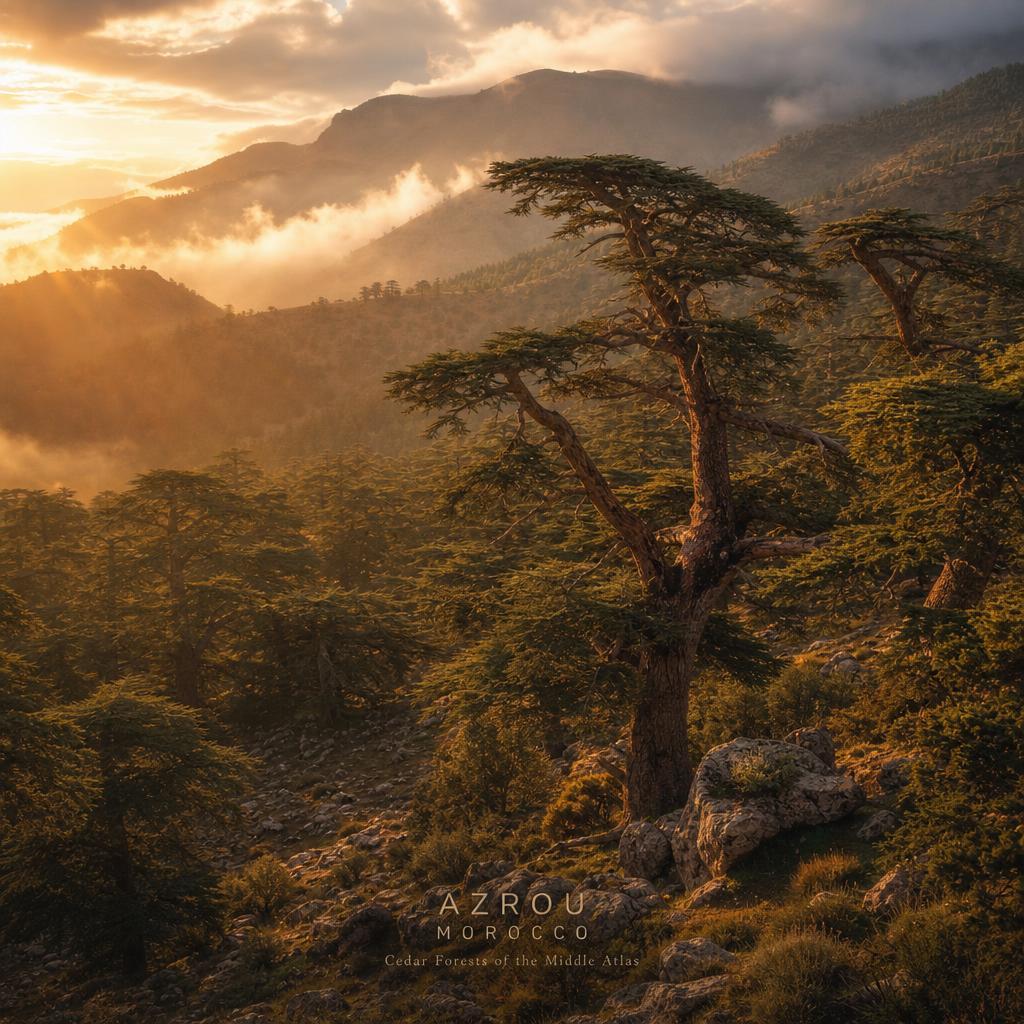
Why Sunrise Light Transforms the Cedar Forest
The cedar forest near Azrou runs along ridges that face east and northeast. When the sun clears the Atlas horizon in early morning, its low angle drives warm shafts of light between the trunks — the kind of light that midday flat overhead conditions simply cannot replicate. The canopy filters this light into soft pools on the forest floor, and on cooler mornings a thin ground mist lingers at the base of the trees, adding depth and atmosphere to wide compositions.
Shadow geometry is the other advantage of arriving early. Long shadows emphasize the girth of individual cedars, and the alternating bands of light and dark create natural leading lines that pull a viewer's eye toward a focal point. As the sun rises higher this geometry flattens quickly, which is why most experienced forest photographers pack up by mid-morning and return in late afternoon. Verify current sunrise times locally before you plan, as they shift noticeably between June and August.
Choosing Your Position Before the Light Arrives
Scouting the evening before is one of the most effective things you can do. Walk the forest path in soft afternoon light and identify three or four potential compositions: a tall trunk with clear sky behind it, a mossy clearing that catches open light, a bend in the path that creates depth. Mark these locations or photograph them as reference, so the next morning you move purposefully rather than searching in low light.
When you arrive at your position before dawn, resist the urge to set up immediately on the most obvious viewpoint. Walk five to ten metres either side and look at the same scene from a different angle — the change in trunk spacing or the shift in background complexity can dramatically improve or simplify a composition. A tripod helps with the longer exposures of pre-dawn shots and forces a deliberate framing process that hand-holding rarely encourages.
- Arrive at least 20 minutes before sunrise
- Scout the evening before and note 3–4 specific compositions
- Bring a small flashlight for navigating to your position in the dark
- A tripod is valuable for pre-dawn exposures
- Layer up — the forest is cold before the sun rises
Exposure Settings for Forest Light
Forest sunrise photography is technically demanding because the contrast range between bright sky and shadowed trunks can exceed what a single exposure handles cleanly. If you shoot in a raw file format, expose for the highlights and recover shadow detail in post-processing. If you are shooting JPEG on a phone or compact camera, use exposure compensation to protect the brightest areas — blown-out sky patches are hard to recover, whereas slightly dark shadows respond well to brightening.
As the light strengthens, shift to faster shutter speeds if any breeze is moving the canopy. Upper branches in slight motion create the most visible blur at slow shutter speeds, and while intentional blur can be creative, unintentional blur across your main subject rarely improves an image. ISO performance on modern cameras and phones is strong enough that keeping shutter speed at 1/125 s or faster during the golden period is practical without obvious noise penalties.
Ethical Behaviour in the Forest at Sunrise
Early mornings are when forest wildlife is most active. Move quietly, stay on established paths, and keep voices low. Bright flashes of light or loud sounds disturb birds nesting in the canopy and can push macaques away from their usual morning areas. Natural light is always preferable to flash in forest environments, and it almost always produces better photographs anyway.
Leave the forest exactly as you found it. Do not break branches to clear a composition, move rocks to improve foreground interest, or disturb any animal for a shot. Your local guide can help you find viewpoints that are both photogenic and ecologically low-impact. Always verify current access conditions with your guide before planning a pre-dawn visit, as path conditions and permitted areas can change seasonally.